
Kilimanjaro News Network
The Voice of Africa
UMOJA
NA MAENDELEO


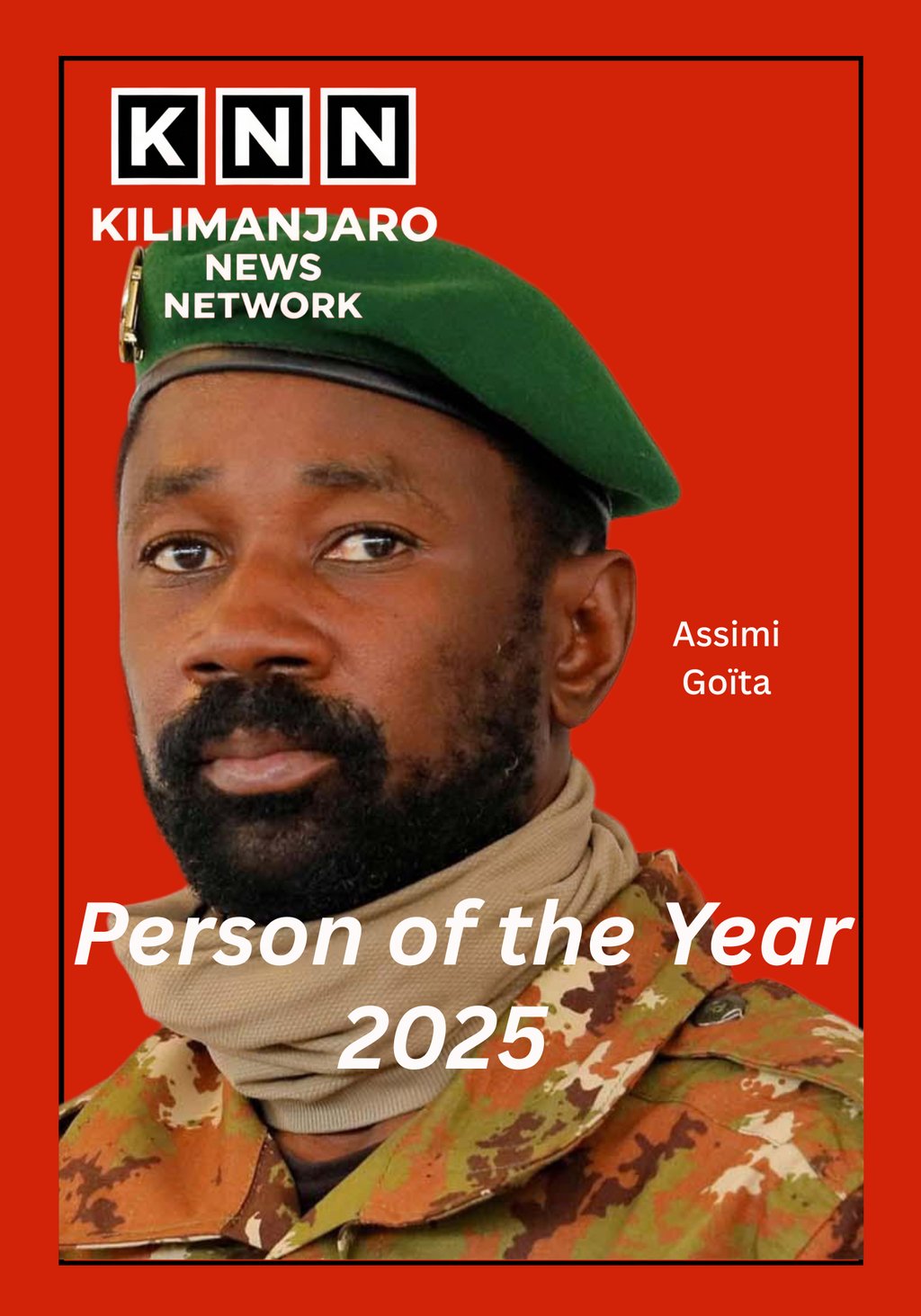
Kilimanjaro News Network Names Colonel Assimi Goïta Person of the Year 2025
Africa did not seek consent in 2025. It moved. This was the year the continent stopped softening its words. The year restraint hardened into resolve, and patience too long confused with wisdom ran out. Across Africa, leaders and power brokers chose friction over favour, sovereignty over approval, consequence over comfort. Agreements once treated as untouchable were re-examined. Economic arrangements marketed as “partnerships” were stripped of their euphemisms. The rules of engagement changed not by degrees, but in one clean break. In the Sahel, that break found its bearing. Colonel Assimi Goïta of Mali emerged not as a steward of reassurance, but as a force of disruption severing ties where they constricted, centralizing authority where fragmentation served external interests, and asserting, without apology, that African dignity is not up for negotiation. His defiance was not isolated. It echoed. From Bamako to Ouagadougou, from Niamey to Addis Ababa, a firmer continental temper began to take hold. This editorial is not an ode to ease. It is a record of resistance. It names the men who, in 2025, pulled Africa back into the centre of its own narrative not by asking to be included, but by taking command. History has little patience for the agreeable. It remembers those who stood their ground. In 2025, that man was Colonel Assimi Goïta.
WORLD AFFAIRS
Kilimanjaro News Network Editorial Board
12/17/20254 min read
PERSON OF THE YEAR 2025
There are years that pass quietly, and there are years that draw a line in history.
2025 belongs to the latter.
Across Africa, something has shifted not loudly, not neatly, but unmistakably. The old reflexes of deference are fading. The inherited grammar of empire is being unlearned. In its place: a harder language of sovereignty, self-interest, and continental self-belief. From the Sahel to the Horn, from boardrooms to barracks, African power is being asserted rather than requested.
This is not a renaissance driven by ceremony or symbolism alone. It is muscular, imperfect, and deeply consequential. Contracts have been rewritten. Alliances recalibrated. Resources reclaimed. Young people long told to look outward for validation are looking inward again, and forward.
Against this backdrop, Kilimanjaro News Network names Colonel Assimi Goïta of Mali as Person of the Year 2025, alongside nine other figures whose actions this year materially altered the balance between dependence and dignity on the continent.
Ranked by their impact on sovereignty, economic self-reliance, and pan-African alignment, these ten men represent something more than leadership. They represent a refusal.
Colonel Assimi Goïta — Mali
Man of the Year | The Unbreakable Shield of Sahelian Sovereignty
Assimi Goïta does not govern to be liked. He governs to be free.
Five years after seizing power, the Malian leader has done what few post-coup rulers manage: consolidate authority while redefining the terms of engagement between Africa and the outside world. In 2025, Goïta moved decisively to suspend exploitative, colonial-era mining contracts, redirecting strategic revenues back into Malian control. The message was blunt and overdue Africa’s soil is not an open ledger for foreign balance sheets.
More consequential still has been his role in solidifying the Alliance of Sahel States (AES) alongside Burkina Faso and Niger. What began as a security pact has evolved into a geopolitical statement: the Sahel will no longer subcontract its sovereignty. In an era of proxy wars and conditional partnerships, Goïta’s Mali has chosen alignment over appeasement.
When external pressure followed as it inevitably does, Goïta responded with reciprocity, not retreat. Even diplomatic slights, including punitive visa measures from Washington, were met with firm counteraction. Mali, he made clear, is not business as usual.
In stabilizing a nation under siege while reigniting pan-African self-respect, Goïta has become more than a transitional leader. He has become a symbol proof that dignity, once asserted, can be defended.
Other Honourable Mentions:
Captain Ibrahim Traoré — Burkina Faso
The Charismatic Flame of a New Generation
At 37, Ibrahim Traoré governs with the urgency of someone who understands time is Africa’s most stolen resource. In 2025, Burkina Faso nationalized key gold assets, redirected proceeds into domestic industry, and slashed food imports through targeted agro-processing investments. His rhetoric is incendiary, yes but it is matched by policy.
Traoré’s appeal lies not only in what he says, but in what he dares to attempt: a Sankarist experiment updated for a disillusioned generation. For millions of young Africans, he has made sovereignty feel contemporary again.
General Abdourahamane Tchiani — Niger
The Architect of Resource Nationalism
Niger’s long history as a uranium outpost for foreign interests met a quiet reckoning in 2025. Under Tchiani, contracts were renegotiated, refining capacity localized, and revenues redirected toward infrastructure. His leadership style is austere, his strategy unmistakable: Africa’s resources must first serve Africans.
Within the AES framework, Tchiani has been less a firebrand than a builder—fortifying alliances, insulating policy from external leverage, and reinforcing the Sahel’s collective spine.
Aliko Dangote — Nigeria
The Industrialist Who Thinks Continentally
Dangote’s genius in 2025 was scale with intent. From billion-dollar investments in Zimbabwe to parallel expansions in Ethiopia, his industrial footprint tightened Africa’s internal supply chains while loosening dependence on imports. Cement, fuel, power unsexy, essential things. Nation-building materials.
Dangote continues to demonstrate that pan-Africanism can be profitable, and that profit need not be extractive to be powerful.
Prime Minister Abiy Ahmed — Ethiopia
The Dam Builder Who Rewrote the Nile Conversation
The inauguration of the Grand Ethiopian Renaissance Dam in 2025 was not merely an engineering milestone. It was a geopolitical declaration. With 5,150 MW of capacity and regional power exports now underway, Ethiopia repositioned itself as East Africa’s energy anchor.
Abiy’s reforms economic liberalization, infrastructure expansion, and diplomatic balancing, remain controversial. But on GERD, history is unlikely to hedge: Africa’s waters were claimed for Africa’s future.
President Abdel Fattah el-Sisi — Egypt
Custodian of Continuity and Scale
Egypt’s unveiling of the Grand Egyptian Museum in 2025 was cultural statecraft at its most ambitious history reclaimed, tourism revitalized, identity asserted. Beyond symbolism, el-Sisi’s role as a regional stabilizer, BRICS participant, and infrastructure maximalist has kept Egypt positioned as North Africa’s immovable pillar.
President Cyril Ramaphosa — South Africa
The Diplomat Who Refused Silence
As G20 chair, Ramaphosa forced African priorities into rooms that have long spoken over them. From energy transition financing to international legal challenges against modern apartheid, South Africa under his watch insisted that global order cannot remain morally selective.
Strive Masiyiwa — Zimbabwe
The Technologist Defying Digital Colonialism
By launching Africa’s first AI factory and expanding fibre access to tens of millions, Masiyiwa spent 2025 doing what states often struggle to do: building digital sovereignty. His insistence that African data be trained, stored, and leveraged on African terms marks a turning point in the continent’s tech future.
Tony Elumelu — Nigeria
The Architect of Mass Entrepreneurship
Twenty-one thousand entrepreneurs funded in a single year. Millions of jobs catalysed. Billions in generated revenue. Elumelu’s Africapitalism has matured from philosophy into infrastructure, quietly shifting Africa’s economic centre of gravity toward its own people.
Mohammed Dewji — Tanzania
The Industrialist of Ethical Scale
Through MeTL Group, Dewji expanded manufacturing, agro-processing, and energy across eight countries while deepening local value chains. His model, profit with proximity, growth with responsibility, offers a compelling counter-narrative to extractive capitalism.
The Verdict
Africa’s trajectory in 2025 was not smooth. It was contested, pressured, and resisted. Which is precisely why it mattered.
Assimi Goïta stands at the centre of this moment not because he is flawless, but because he is immovable. Around him, these nine figures soldiers, statesmen, industrialists, and builders, collectively signal a continental truth: Africa is no longer negotiating its right to exist on its own terms.
The era of polite dependence is ending.
What replaces it is still being written but the authors are finally African.
Kilimanjaro News Network salutes the men shaping that future.